
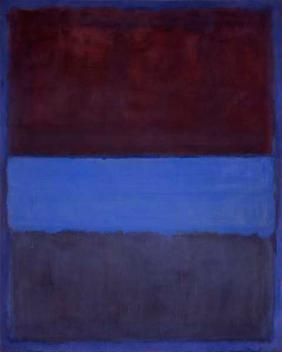
Mark Rothko, No. 61 (Rust and Blue), 1953. Los Angeles County Museum of Art. The painting that would not let go.
“A painting is not a picture of an experience. It is an experience.” — Mark Rothko
I must confess: I love Rothko.
Not with the cool, academic respect you train yourself to perform in the halls of the Sotheby’s Institute. Not with the calculated connoisseur’s eye I spent years using for other things — tracing provenance gaps, reading authentication reports, checking paper for watermarks. No. I love Rothko the way you love someone you trust without knowing exactly why. The way you trust a person who says nothing to you and yet means everything.
That is not an intellectual position. It is a stance.
And I know that sounds suspicious in certain circles. For years a well-stocked intellectual front has dismissed Rothko as overrated, as religiously charged self-promotion, as a marketing product of the New York School. Nice fields, they say. Attractive pictures. As if beauty were a weakness.
I say: these people have never truly stood before a Rothko.
Marcus Rothkowitz, born 1903 in Daugavpils, Latvia — then still the Russian Empire — arrived in the United States at the age of ten. Portland, Oregon. A Jewish child in a world that wanted nothing from him. He became a painter because he found no other language. That sounds romantic. It was not. It was necessity.
What Rothko wanted, he stated himself — and rarely has a painter declared his intention so directly and so unreservedly: “I’m not an abstractionist. I’m not interested in the relationship of color or form or anything else. I’m interested only in expressing basic human emotions — tragedy, ecstasy, doom.”
That is not a manifesto. That is a confession.
And now I come to the work that has never let me go.
No. 61 (Rust and Blue), 1953. Los Angeles County Museum of Art. 295 × 232 centimeters. Rust-brown above, a rich, almost painful blue-violet below. No frame separating the fields — they breathe into one another, the edges soft as the passage between sleep and waking.
I first saw this painting in a catalogue, at twenty, during my studies at the Humboldt. I thought: beautiful. Then I turned the page.
Ten years later I stood before the original. And I did not turn the page.
The painting has a temperature. The rust-brown is not autumn and not blood — it is both simultaneously and neither. The blue below is not sky, not water, not night — it is the moment when you no longer know what you feel, and you stop fighting it. Rothko built that with paint. Without figure. Without gesture. Without apology.
That is courage. Not genius — courage.
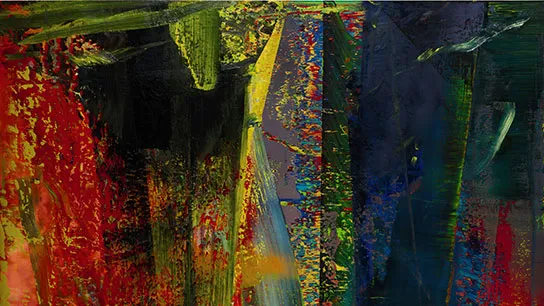
Gerhard Richter, Abstraktes Bild (599), 1986. The squeegee painting that sold for over 46 million dollars — and refused, in every way, to be loved simply.
Then comes 1958. The most important episode in Rothko’s life, and the most puzzling.
The architect Philip Johnson commissions him for the Four Seasons Restaurant in the Seagram Building, New York. The most expensive building in the city. The wealthiest people in the world would eat there. Rothko accepts — and receives what was then the largest fee ever paid to an American painter.
He works on it for a year. Thirty canvases. Large, dark rectangles — wine-red, bordeaux, almost black. He does not want to paint pictures. He wants to build walls. An environment that encloses the visitor, confines them, confronts them. “I hope to paint something that will ruin the appetite of every son-of-a-bitch who ever eats in that room,” he is said to have told a friend.
Then he eats there himself. Once. He sits down, looks at the walls, orders wine — and then: he returns the commission. The entire fee. He gives it all back.
Part of the Seagram Murals hangs today in the Tate Modern in London. Another part in the National Gallery of Art in Washington. I saw them in London — in a dedicated room, with dimmed light, precisely as Rothko had imagined it. No restaurant. No wealthy people with appetizers.
And you know what? It works. The room closes around you. You stay, though you hadn’t planned to.
That is not an intellectual narrative. That is painting.
And then there is Gerhard Richter.
I will be honest now, even though it costs me something.
Richter is an extraordinary painter. Abstraktes Bild 599, 1986 — made with the squeegee, that pulled, layered, overwashed color storm in red and grey — is technically executed with a sovereignty that makes you dizzy. In the 1980s he developed a technique I briefly considered revolutionary: no brush, but a blade, a tool without a handwriting. The paint is not applied — it is moved, displaced, negotiated.
But Richter does not trust the painting.
That is his nature and his problem. He is a man who paints and simultaneously suspects his own painting. He photographs and doubts photography. He is the only artist I know who consistently works against himself — and in doing so produces things of such overwhelming aesthetic power that you almost forget what he is actually doing.
What is he doing? He is preventing. He prevents a painting from speaking to you. The wiping, the overpainting, the blurring of the figurative layers beneath the abstract ones — that is not a method. It is a philosophy of distrust. You will not give this painting meaning, Richter says. Because I take it from you before you begin.
I understand that. Intellectually I even admire it. Richter comes from Waltersdorf, Saxony, the GDR. As a young man he saw murals painted for the NSDAP. He lived in a state that used images as weapons — both in the Third Reich and in the GDR. His distrust of meaning is not a pose. It is a scar.
But I cannot follow him.
Because painting that actively prevents itself from working is, for me, no longer a conversation. It is a monologue about the failure of conversation. And that is — for all its formal brilliance — ultimately a pessimistic, an exhausted stance.
There is a Rothko quote I know by heart. Not because I learned it. Because it settled somewhere between ribs and lungs, and never left:
“A painting is not a picture of an experience. It is an experience.”
That is the difference.
Richter paints pictures of pictures. Photos of photos. Abstractions of abstractions. He doubles, mirrors, shifts — and in doing so always withdraws from direct contact. That is brilliant. It is also a form of cowardice.
Rothko paints the thing itself. The experience. Not the representation. He makes the painting into an event — and he risks, in doing so, that it fails, that it becomes kitsch, that someone walks in and says: nice fields. That is the risk he takes. And he takes it every time again.
That is why I love him.
Not because he is always right. Not because the Chapel in Houston — those fourteen dark, almost black panels he painted in 1967 for an ecumenical sacred space — is not sometimes overwhelming and demanding. But because he decided to risk it. To risk everything. The whole person.
Rothko took his own life on February 25th, 1970, in his New York studio. He was 66 years old.
I will not speculate. I will not psychologize. I know enough people who have been destroyed by things that looked like success from the outside.
What I know: he painted until the end. The last pictures — grey on grey, almost monochromatic — have a stillness I cannot describe. Not exhaustion. Not resignation. Something else. Something like arrival.
Richter is still alive. Born in 1932, still making work, still selling for absurd sums, still refusing clarity.
I wish him well.
But when I cannot sleep at night — which happens in Stammheim, more often than you’d think — and I need a painting that does not explain to me what I should feel, but simply sits there and waits until I come: that is Rothko.
No. 61. Rust and Blue.
The rust-brown and the blue-violet, breathing into each other.
And me in between.
Anfam, David. Mark Rothko: The Works on Canvas. Yale University Press, 1998. — Buchloh, Benjamin H.D. Gerhard Richter: Painting after the Subject of History. MIT Press, 2010. — Elderfield, John (ed.). Modern Painting and Sculpture: 1880 to the Present. MoMA, 2004. — Rothko, Mark. The Artist’s Reality: Philosophies of Art. Yale University Press, 2004. — Storr, Robert. Gerhard Richter: Forty Years of Painting. MoMA, 2002.