
MA Dissertation, Sotheby's Institute of Art London
"The copy is not inferior to the original. It is a different argument for the same truth." — B. Frings, working notes, London 1996
Pieter Brueghel the Younger has never been forgiven for his father. This is, when you examine it carefully, an unusual kind of crime. Most artists who follow in the wake of a great predecessor are blamed for deviating too far — for betraying the tradition, for being insufficiently reverential. The younger Brueghel is blamed for the opposite: for being too faithful. For copying. For repeating. For not inventing himself out of his father's shadow.
The standard biographical verdict runs something like this: Pieter Brueghel the Younger (1564–1638), born in Brussels, orphaned at five, trained by his grandmother, a competent craftsman, commercially successful, spiritually derivative. His workshop produced — and here the statistics are intended to impress and diminish simultaneously — some 1,400 pictures with plausible links to his hand or his studio. Sixty copies of the Winter Landscape with Skaters and a Bird-Trap alone. Thirty of the Adoration of the Magi in the Snow. Twenty-five of the Preaching of Saint John the Baptist. The numbers are meant to tell a story about assembly-line mediocrity. A great man's son, selling his father's glory by the yard.
I want to argue that this verdict is not simply unfair. I want to argue that it is built on a philosophical assumption so thoroughly anachronistic, so deeply contaminated by Romantic ideology, that it cannot stand up to examination. The assumption is this: that the original is sacred, and the copy is its diminished shadow. That authenticity resides in the unrepeated gesture. That an artist who repeats has, by definition, run out of things to say.
This assumption has a history. It is not eternal. It was not shared by the painters of Antwerp in 1600. It would not have been recognised as an assumption at all in the workshop culture of the Southern Netherlands in the late sixteenth century. It is, in fact, a relatively recent invention — and like all inventions dressed up as nature, it is worth examining what interests it serves.
My thesis is the one I have carried since I first encountered this question, in a seminar room in Berlin where a slide of the Winter Landscape appeared on the screen and a professor said, with a confidence I found immediately suspicious: "Here, the son merely reproduces what the father created." I thought then, and I think now, that the word merely was doing a great deal of unexamined work.
Pieter Brueghel the Younger did not copy because nothing occurred to him. He copied because he believed — I would argue, on good evidence, consciously and deliberately — that the concept of the original was a fiction. An invention of vanity. And he chose to repeat his father's compositions not as a kind of aesthetic inheritance, but as an act of intellectual fidelity to what those compositions meant. He was, in a sense I will take time to develop, a publisher. A disseminator. A man who understood that the power of an image lies not in its uniqueness but in its capacity to be seen — and seen again, and again, and again.
_-_Winterlandschap_met_schaatsers_en_vogelknip%252C_1565.jpeg)
Pieter Bruegel the Younger - Winter Landscape with a Bird Trap
Before we can understand Brueghel the Younger's practice, we need to understand the world in which it was conducted. This requires a brief, and perhaps uncomfortable, confrontation with how much of our understanding of artistic value is specific to a particular historical moment.
The workshop culture of Antwerp in the late sixteenth and early seventeenth centuries operated under a set of assumptions about authorship, originality, and the purpose of images that are almost entirely foreign to post-Romantic art criticism. In this world, the primary unit of production was not the individual genius but the workshop — a collaborative enterprise in which masters, journeymen, and apprentices worked together, often on the same panel. Attribution in the modern sense was frequently impossible and frequently irrelevant. What mattered was the quality of the output and the reliability of the iconography.
Copying was not stigmatised. It was, in many respects, the foundational practice of the entire system. Apprentices learned by copying. Masters extended their repertoires by copying. Collectors commissioned copies when they could not obtain originals — and this was not considered a second-best solution. It was a normal, respected, economically rational arrangement. The Guild of Saint Luke, to which Pieter Brueghel the Younger was admitted as an independent master in 1585, operated within a system in which images were understood as types — recognisable, repeatable, valuable precisely because they could be disseminated.
This is not to say that there was no concept of the original in the early modern Netherlandish world. Of course there was. But it was a different concept. An original was the first instance of a composition, the source from which others derived. It was valued. It commanded a higher price, because it was the origin. But the copies were not thereby worthless. They were, in a sense, the original's proof of importance. A composition that was copied many times was, by that very fact, demonstrated to be significant. The copies testified to the original's power rather than diminishing it.
We know that Pieter Brueghel the Elder's works were sought after and difficult to access. By the time his son was working, many of the Elder's masterpieces had passed into the great private collections of Europe — into the imperial collection of Rudolf II in Prague, into the Farnese collection in Parma — where they were effectively invisible to all but their owners. Brueghel the Younger's copies were not competing with his father's originals. They were making those originals' arguments available to a public that would otherwise never have encountered them. This is, when you consider it without anachronistic prejudice, an act of considerable cultural generosity.
To understand why this matters philosophically, we need to understand what Pieter Bruegel the Elder was actually doing in his peasant scenes — because the conventional account gets this wrong too.
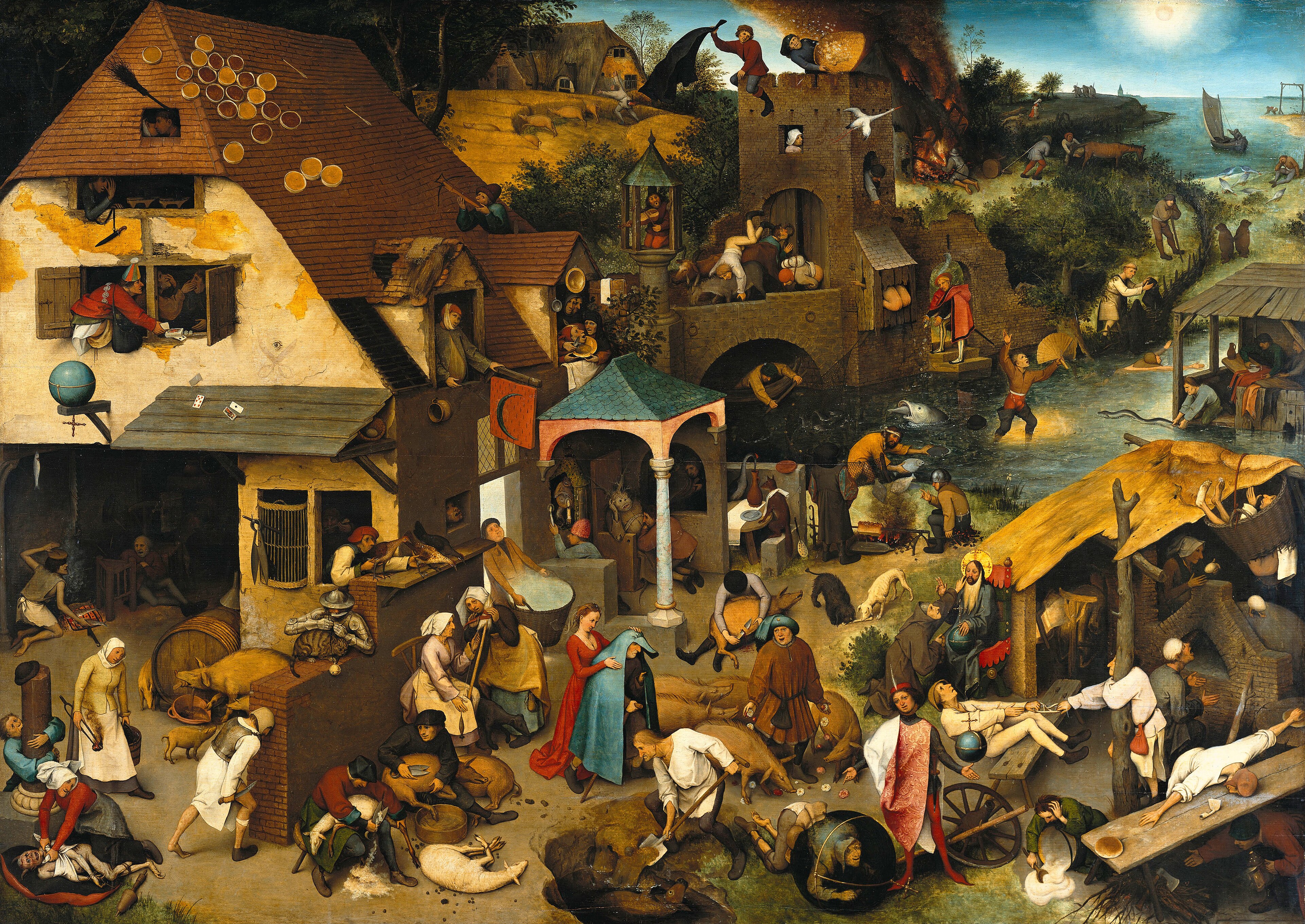
The peasant paintings are not picturesque. They are not affectionate. They are not the Northern European equivalent of pastoral poetry, celebrating a simpler life with the comfortable condescension of the educated viewer. They are, on examination, disturbing and precise. The peasants of The Peasant Wedding are absorbed, unreflective, consuming. The figures in Children's Games perform their activities with an intensity that is almost alarming — these are not children at play but something more like a taxonomy of human folly rendered in miniature. The Netherlandish Proverbs (the painting we now call The Dutch Proverbs) is a comprehensive inventory of human stupidity: more than a hundred proverbs illustrated in a single canvas, a world in which everyone is busily making a fool of themselves, and no one notices.
The intellectual background here is well established. Bruegel the Elder moved in humanist circles in Antwerp. He was close to the printer and publisher Christopher Plantin, who was also the publisher of Erasmus. He was the friend and probably the collaborator of the cartographer Abraham Ortelius. The influence of Erasmus's Praise of Folly (1511) — that foundational text of Northern humanist satire, in which the goddess Folly praises herself and catalogues the endless variety of human self-deception — is not incidental to Bruegel's peasant paintings. It is constitutive of them.
The peasants are us. The chaos, the absorption in petty pleasures, the inability to see beyond the immediate satisfaction — these are not characteristics of a lower social class. They are characteristics of the human. Bruegel the Elder is not painting peasants because he finds them quaint. He is painting the human condition using peasants as a shorthand, in the same way that Erasmus uses learned fools and pompous clerics. The setting is low, deliberately, to make the point that grandeur is not available to us. We are all equally ridiculous.
This is a philosophical programme. It has moral stakes. And it is expressed, insistently, through visual means — through the chaos of composition, the absence of hierarchy, the refusal of the heroic single figure. No one in a Bruegel the Elder peasant scene is more important than anyone else. The composition itself embodies the argument: we are all the same, all equally trapped in our folly, all equally visible from the outside.
Now: if this is what the paintings mean — if this is their content, their argument, their philosophical payload — then the question of whether a given version was touched by the Elder's hand or the Younger's becomes secondary to the question of whether the argument is being made. And the Younger's copies make the argument. That is what they do. That is, I am suggesting, what they were intended to do.
Here is what we know about Pieter Brueghel the Younger's relationship to his father's work. He was five years old when his father died. He did not know him. He had no direct access to most of his father's major paintings, which had dispersed into elite collections. He learned his father's compositions through his grandmother, Mayken Verhulst — herself a considerable miniaturist — and through prints made after his father's works by the printmaker Hieronymus Cock.
This is crucial. Let me sit with it for a moment. The Younger encountered his father primarily through reproductions. Through prints. Through copies. The father was already, for the son, a reproduced image rather than a physical presence. The 'original' was not available. What was available was the argument that the original made — preserved in the medium of print, of memory, of workshop tradition.
And the Younger became a printer in paint. He used the technique of pouncing — the transfer of a composition through a pricked cartoon — to ensure the fidelity of his copies to the source. He was methodical. He was systematic. He sometimes varied the palette, sometimes adjusted the colour temperature toward the warmer tonalities fashionable in the seventeenth century, sometimes omitted or altered details. But the argument stayed. The crowd of fools at their wedding feast stayed. The trap in the snow, indifferent to the skaters, stayed. The tower that no one will ever finish stayed.
I want to propose, quite directly, that Pieter Brueghel the Younger understood what his father had done in a way that most of his father's later admirers have not. He understood that the peasant scenes were not objects for private contemplation. They were public arguments. They were intended to circulate, to be seen, to work on the viewer. And he made them circulate, on a scale his father could never have achieved with a limited number of original panels.
In the terms of a later era, he was what we would call an editor, or a publisher, or a distributor. He recognised that the value of the work lay in its availability — in its capacity to be encountered, to surprise, to instruct. And he made it available.
It is time to address the philosophical objection directly. The objection goes: yes, perhaps copying was legitimate in workshop culture; yes, perhaps the Younger had good intentions; but there is nonetheless something lost when a copy replaces an original. The original carries the trace of a specific hand, a specific moment, a specific intention. The copy, however skilled, is a simulation. And simulations are always, in some measure, fraudulent.
This objection has a serious philosophical pedigree. Nelson Goodman, in Languages of Art (1968), draws a distinction between autographic and allographic works. Autographic works — paintings, sculptures — are defined by the history of their production. A forgery, however indistinguishable from the original, is a different object because it was made differently. The history of production is constitutive of identity. Allographic works — musical scores, literary texts — are identified by their notational structure. A performance of Beethoven's Fifth by a mediocre orchestra is still a performance of Beethoven's Fifth. But a copy of the Mona Lisa is never the Mona Lisa, even if you cannot tell the difference.
This is a rigorous argument. But it has a hidden presupposition: that what matters about a painting is its identity as an object. If what matters is the argument the painting makes — if the painting is, in the terms I have been using, primarily a vehicle for content — then the distinction between autographic and allographic begins to dissolve. A highly faithful copy of The Peasant Wedding makes the same argument as the original. The fool with his mouth open, the piper absorbed in his pipe, the absence of anyone paying attention to anything beyond their immediate appetite — these are there. They work on you. They deliver Erasmus.
Walter Benjamin, writing in 1935, saw the reproducibility of the artwork as a loss — the loss of what he called the aura, the quality of presence attached to the unique original, its situatedness in time and place. Benjamin was describing photography and film, technologies of mechanical reproduction. But his concept of aura was also, I think, a late articulation of a much older assumption: that the original is sacred because it is unrepeatable.
Benjamin is a critic I admire, but I want to turn his argument slightly. He writes: "The authenticity of a thing is the essence of all that is transmissible from its beginning, ranging from its substantive duration to its testimony to the history which it has experienced." This is beautiful, and I do not want to dismiss it. But I want to ask: for Bruegel the Elder's peasant paintings, what is the testimony they carry? Is it testimony to the specific chemical composition of a paint layer in the 1560s? Or is it testimony to a vision of the human — a mordant, humanist, Erasmian vision of our collective foolishness?
If it is the latter — and I am convinced it is — then the Younger's copies carry that testimony with full fidelity. They are not lesser transmissions. They are transmissions.
There is a second philosophical tradition that I find more useful for this argument, and it runs through Gilles Deleuze. In Difference and Repetition (1968), Deleuze argues that repetition is not mere sameness — that every act of repetition produces difference, that repetition is a creative force rather than a mechanical function. To repeat something is not to diminish it. It is to encounter it again, to discover what is still alive in it, to test whether its argument still holds.
Brueghel the Younger repeated his father's compositions across a forty-year career. Each repetition was an encounter. Each version was a test: does the argument still work? Can the trap in the snow still catch a viewer? Can the chaos of the peasant wedding still reveal something true about how we eat and drink and fail to see each other?
The answer, evidently, was yes. The demand for these copies did not diminish across the Younger's career. If anything, it increased. This is not evidence of a public that was being deceived into purchasing inferior goods. It is evidence that the argument continued to land.
I want to introduce an analogy that may seem anachronistic but which I believe illuminates something genuine. In the twentieth century, we became familiar with the idea of broadcast — the single transmission reaching many receivers simultaneously or in sequence. The invention of print in the fifteenth century was the first great European broadcast technology. What Gutenberg enabled for texts, printmakers like Hieronymus Cock were enabling for images in the Low Countries of the sixteenth century.
Bruegel the Elder understood this. He collaborated with Cock on prints of several of his compositions. He was not indifferent to dissemination. He understood that an image engraved and printed in an edition of hundreds had a reach that a unique painted panel never could. The printed versions of The Big Fish Eat the Little Fish, The Blind Leading the Blind, and other compositions reached audiences across Europe that the paintings themselves could never have reached.
The Younger extended this logic into the medium of paint. His workshop was, in a real sense, a print shop that worked in oil. He produced multiple versions of the most resonant compositions — sometimes a dozen, sometimes thirty, sometimes sixty — and these versions spread across the Flemish art market, into the hands of collectors who could not aspire to an original but could aspire to the argument. The Winter Landscape hung in the halls of the minor nobility, in the offices of prosperous merchants, in the homes of the educated bourgeoisie. Everywhere it hung, it asked its quiet question: do you see the trap?
The trap in the snow — that motif of a wooden cage propped on a stick, designed to catch birds, positioned in the foreground of a cheerful winter scene full of skaters — is one of the most perfect emblems in the history of Western painting. The skaters glide past it without noticing. They are absorbed in movement, in pleasure, in each other. The trap waits. Every viewer who sees it sees themselves in the skaters, and feels, for a moment, the discomfort of recognition. That is what the painting does. That is what sixty copies of it did. Six hundred people in Flanders and beyond were given that discomfort, that recognition.
Is this diminished by the fact that most of them were looking at Pieter Brueghel the Younger's hand rather than his father's? I cannot see how.
The objection I anticipate here is the Romantic one, and it is the most persistent. The Romantic theory of artistic value — which remains deeply embedded in how we teach and write about art, despite its historical specificity — holds that the value of an artwork is inseparable from its status as the expression of a unique individual consciousness. The work is valuable because it is the trace of a particular person's encounter with the world. Repetition, on this account, is self-betrayal: the artist who copies has abandoned the central task, which is to look freshly, to see newly, to report from the frontier of perception.
This theory was formulated — crystallised, really — in the late eighteenth and early nineteenth centuries by thinkers like Kant (on aesthetic judgment as individual and non-conceptual), Schiller (on artistic freedom as the expression of personality), and most powerfully by the German Romantics, for whom genius was by definition non-repeatable. It was also, not coincidentally, the ideology of an art market increasingly organised around the premium on uniqueness. If every painting must be an original expression, then uniqueness is intrinsically valuable, and its value can be monetised.
I am not saying the Romantic theory is worthless. I am saying that it is a theory — a historically specific set of assumptions about what art is for and what makes it valuable — and that it should not be applied retrospectively to a painter working in Antwerp in 1600, who operated within a completely different set of assumptions.
If we want to understand Pieter Brueghel the Younger on his own terms, we need a different theory. We need, perhaps, the medieval one.
There is a tradition of image-making that predates the Romantic theory by centuries and that offers, I think, a more useful framework for understanding what the Younger was doing. It is the tradition of the sacred copy.
In Byzantine icon painting, the copy is not a lesser thing than the original. It is, in a theological sense, the same thing. The icon of the Theotokos — the Virgin and Child — is not sacred because this particular board was touched by this particular brush in this particular year. It is sacred because it participates in a transcendent image, of which every faithful copy is a full instantiation. To copy an icon faithfully is not to diminish the original. It is to extend its presence. To make it available in another place. To bring its power — its capacity to mediate between the visible and the invisible — to another community of viewers.
I am not suggesting that Brueghel the Younger was a theologian, or that his peasant copies had the explicit function of sacred icons. But the structural logic is similar. The Winter Landscape is not sacred, but it carries something — a vision, a moral argument, an insight about the human condition — that has a claim to be transmitted. To copy it faithfully is to transmit that something. To multiply it is to extend its reach.
This logic was not foreign to the world of Flemish painting. The devotional diptychs and triptychs of the earlier Netherlandish tradition had generated a culture of careful, purposeful copying. Jan van Eyck's compositions were copied by workshop assistants, by independent masters, by entire schools of followers. No one accused the Flemish tradition of being thereby diminished. On the contrary, the copies testified to the originals' power and extended their influence.
Brueghel the Younger stands in this tradition more than in the tradition of the Romantic original. He is, in the deepest sense, a faithful copyist — faithful not to the surface of the original, not to its material identity, but to its argument.
One of the most interesting things about Brueghel the Younger's copies is that they are not always identical to the originals. They modify. They adjust. Sometimes they omit figures. Sometimes they change the palette. In the copies of The Preaching of Saint John the Baptist, some versions omit a prominent bearded man in black who faces the viewer directly in the Elder's original — a figure scholars have long speculated may be a self-portrait of the Elder, or a portrait of his patron.
This is not evidence of careless or inadequate copying. It is evidence of active interpretation. The Younger was not transcribing. He was editing. He was making decisions about what, in his father's compositions, was essential and what was circumstantial. The omission of the black-clad figure in some versions of the Preaching may reflect a changed political context — by the time the Younger was working, the explicitly Protestant subtext of the original had faded in relevance — or it may reflect a deliberate choice to make the composition more universally accessible. Either way, it is an intelligent decision made by someone who understood the work he was copying.
This modifying practice connects to something important in Deleuze's account of repetition. For Deleuze, repetition is never mere replication: it always produces difference, because the conditions of repetition are never identical to the conditions of the original. The Younger copied his father's compositions into a different decade, a different market, a different political climate, a different stylistic context. The colours shifted toward the warmer, more saturated palette of the seventeenth century. The drawing became slightly harder, more defined. The copies are, in Deleuzian terms, repetitions-with-difference: they carry the original's argument but inflect it through the conditions of a new historical moment.
This is not failure. It is translation. And translation, as every serious reader of Walter Benjamin's essay The Task of the Translator (1921) knows, is not the production of a copy but the production of a new life for an original argument.
I want to address, briefly, the commercial dimension of this story, because it is sometimes used against Brueghel the Younger in a way I find logically confused.
The argument runs: he copied his father's works because they were commercially successful; his copying was motivated by profit rather than by artistic vision; therefore the copies are commercially rather than artistically significant; therefore they are less valuable as art.
This argument confuses motivation with quality and commercial success with artistic failure — three distinct things, all of which need to be disentangled.
First, motivation: the Younger was a professional painter in a commercial city. He ran a workshop. He had seven children (many of whom died young), he paid rent, he had apprentices to train and journeymen to pay. His copies sold. This is a fact about the structure of the Antwerp art market, not evidence of his moral or artistic failure. Rembrandt also made his most commercially successful works deliberately for the market. Raphael ran a large workshop that produced work by assistants and sold it under his name. The commercial dimension of artistic practice does not, by itself, tell us anything about the quality or the significance of the work.
Second, success: the enduring demand for Brueghel the Younger's copies tells us something important about their function. They were not purchased by naive collectors who didn't know what they were buying. The buyers of the Antwerp art market in the early seventeenth century were sophisticated, internationally connected, and well aware of the distinction between an original and a copy. They bought the copies anyway. This suggests that what they were buying was not the Elder's touch — not the auratic residue of a specific hand — but the argument. The image. The trap in the snow.
Third, and most importantly: the commercial success of the copies is, in a sense, evidence for my thesis. If the Elder's paintings were intended — as I believe they were — as philosophical arguments about the human condition, then their wide distribution is precisely what they were for. The copies that sold well were not betraying the Elder's project. They were fulfilling it.
There is something in the art-historical preference for the original that I recognise as a kind of nostalgia — and I use the word in its etymological sense, as a longing for return, for an inaccessible origin. The original painting is imagined as a point of pure contact: the master's brush on the master's panel, the full, unmediated presence of a creative intelligence. The copy is everything that falls short of this imagined purity.
But the origin is always already lost. Pieter Bruegel the Elder is dead. His hand does not touch anything. What remains of him is distributed across multiple objects — original paintings, prints, copies, written records, the visual tradition his work inaugurated. The Winter Landscape in the Musées Royaux des Beaux-Arts in Brussels and the sixty copies of it made in his son's workshop are all equally parts of what 'Bruegel' means in the world. To privilege one at the expense of the others is to perform a piety that the Elder himself, with his taste for the satirical and the anti-hierarchical, would probably have found amusing.
Andy Warhol understood this. When he painted thirty-two versions of a Campbell's Soup can, he was not commenting on the soup. He was commenting on the assumption — still alive, still pernicious — that the unique gesture is more valuable than the repeated one. He was, in a sense, making the same argument that Pieter Brueghel the Younger had made four centuries earlier, in a different medium, for a different market. Both of them were saying: the argument is more important than the instance. The image belongs to whoever needs it.
Let me state my thesis one final time, as directly as I can.
Pieter Brueghel the Younger did not copy because nothing occurred to him. He copied because he believed that the concept of the original was a fiction. An invention of vanity. The peasant scenes of his father — loud, chaotic, without heroes, without idealization — had not interested him as an inheritance, as property, as something to own. They had interested him as a statement. A philosophical argument, drawn from Erasmus and the humanist tradition, about the nature of human folly and the impossibility of self-knowledge. And he wanted to repeat that statement. To distribute it. To send it into the world in as many versions as the world would receive.
He was, in this sense, more faithful to his father's intentions than any museum that hangs a single original behind glass and calls it complete.
The fiction of the original is the belief that what matters about an image is where it has been. The alternative — the position I am arguing for, and the position I believe Brueghel the Younger implicitly held — is that what matters is where it is going. Who will see it. What it will do to them. Whether the trap in the snow will still catch them, still make them feel, for a moment, that they have been seen.
It will. That is the point. It always will.
Alpers, Svetlana. The Art of Describing: Dutch Art in the Seventeenth Century. Chicago: University of Chicago Press, 1983.
Benjamin, Walter. "The Work of Art in the Age of Mechanical Reproduction." In Illuminations, edited by Hannah Arendt, translated by Harry Zohn. New York: Schocken Books, 1969 [1935].
Benjamin, Walter. "The Task of the Translator." In Selected Writings, Volume 1: 1913–1926, edited by Marcus Bullock and Michael W. Jennings. Cambridge, MA: Harvard University Press, 1996 [1921].
Deleuze, Gilles. Difference and Repetition. Translated by Paul Patton. New York: Columbia University Press, 1994 [1968].
Erasmus, Desiderius. Praise of Folly. Translated by Betty Radice. London: Penguin, 1993 [1521].
Gibson, Walter S. Bruegel. London: Thames and Hudson, 1977.
Goodman, Nelson. Languages of Art: An Approach to a Theory of Symbols. Indianapolis: Hackett, 1968.
Harbison, Craig. The Mirror of the Artist: Northern Renaissance Art in Its Historical Context. New York: Abrams, 1995.
Hindman, Sandra, and Gabriel Spiegel, eds. Printing the Written Word: The Social History of Books, 1450–1520. Ithaca: Cornell University Press, 1991.
Van Mander, Karel. The Lives of the Illustrious Netherlandish and German Painters [Schilder-boeck, 1604]. Translated and edited by Hessel Miedema. Doornspijk: Davaco, 1994–1996.
Wied, Alexander, and Hans J. Van Miegroet. "Bruegel." In The Dictionary of Art, edited by Jane Turner. Vol. 5. London: Macmillan, 1996.
— Butrus Frings, London, June 1996