
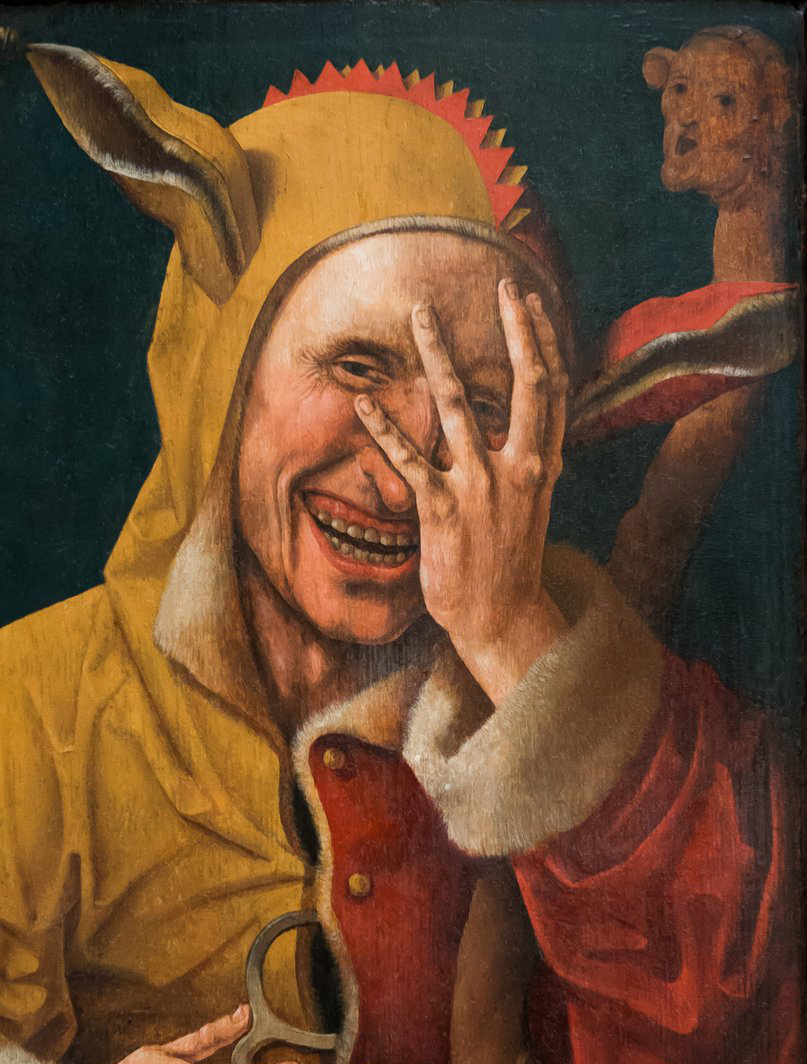
Laughing Fool, Netherlands, c. 1500, possibly Jacob Cornelisz. van Oostsanen. Oil on panel, 35 × 23 cm. Davis Museum, Wellesley College
My face online is not my face. Anyone who follows me on Bluesky sees a fool, painted around 1500 in the Netherlands, perhaps by Jacob Cornelisz. van Oostsanen, perhaps by someone whose name nobody remembers. A wooden panel barely larger than a school exercise book, now in a college museum in Massachusetts. The fool wears a hood with donkey's ears, yellow and green, the colours of inconstancy and disgrace. In one hand he holds the marotte, the stick with a carved fool's head that is laughing too. The other hand he holds in front of his face, fingers spread, and between his fingers he looks at us and laughs.
People have asked me why him of all people. I said: because he looks like me. That was a lie, and at the same time it was the truth. The real reason I'm happy to give away, it's banal: if you put the donkey's ears on yourself, nobody else can put them on you. People don't laugh at a man who is already laughing at himself. They laugh with him, and then the laughter belongs to him. The next three instalments are about sentences of that kind.
The fool's gesture is not a game of hide-and-seek. It is a proverb. Door de vingers zien, to look through one's fingers. German still has it, if old-fashioned: you look through your fingers when you notice something and act as though you hadn't. You turn a blind eye, but one that stays open. Bruegel painted the gesture in 1559 into his Netherlandish Proverbs, among a hundred other follies. And the old moral that goes with it runs roughly like this: whoever cannot look through his fingers is no use in this world.
That is an astonishingly immoral morality. It doesn't say: be just. It says: be lenient, or you won't survive here. It doesn't say: look away. It says: look, and let it go anyway. The fool laughs because he does both at once, he sees everything and condemns nothing. You can call that cowardice. You can call it wisdom. The panel doesn't decide, and that is why it has been hanging somewhere for five hundred years, laughing.
I have worked in places where the proverb is not a piece of wisdom but a currency. Whoever saw something and said nothing is owed something, and one day the debt is called in. Whoever saw something and says everything doesn't live there long. In Sanaa I watched a city fall apart and saw what then comes onto the market, out of houses whose owners can no longer ask where their things have gone. I have seen what people do to one another to get rich, and sometimes simply because they enjoy it. Looking through your fingers is neither vice nor virtue there. It is the condition for still doing business tomorrow.
And I have seen the opposite: offices and authorities where every step is registered and every door has a log. A world in which everything is seen and nothing is forgiven. Believe me: a world without fingers in front of its eyes is not a more just world. It is merely better lit.
The court jester held a strange position. He was the lowest at court, property rather than person, and he was the only one allowed to tell the king he was naked. The word for this in German is Narrenfreiheit, the fool's licence, and it is usually misunderstood. People think the fool could say anything because nobody took him seriously. That is only half true. He could say anything because he said it as play. The truth came in disguise, with bells and donkey's ears, and because it came in disguise the king could accept it without losing face. The fool's lie, that it was all just a joke, was the condition of his truth.
In 1509 Erasmus of Rotterdam made a book of this, in the house of his friend Thomas More, within a few weeks, supposedly ill in bed. The Praise of Folly. It is not Erasmus who speaks in it, but Folly herself, an invented lady named Stultitia, who praises her own merits from the pulpit. She mocks the monks, the theologians, the popes, the princes, the scholars, and in the end herself. Erasmus could not have said all that under his own name, at least not for long. Under hers he could. The book became a bestseller, and when he was accused of insulting the Church he could say: Me? That was Folly.
Was that dishonest? Erasmus deceived no one. Everyone knew who had written the book. And yet the invention achieved something the truth alone could not: it opened a space in which you were allowed to laugh before you were outraged. In that space the criticism did its work. The invented figure was not a hiding place. It was a tool.
Four hundred years later, in Lisbon, a small clerk in hat and glasses translated business letters for trading firms and at night invented an entire literature. Fernando Pessoa did not write under a pseudonym. He wrote under more than seventy. He did not call them pseudonyms but heteronyms, other names, and that was a distinction he insisted on. Alberto Caeiro, the shepherd who did not want to think. Ricardo Reis, the doctor who wrote classical odes and emigrated to Brazil. Álvaro de Campos, the naval engineer who had studied in Glasgow and sang of machines. Each had a date of birth, a horoscope, a handwriting, a worldview. They wrote each other letters, contradicted each other, reviewed each other. Caeiro was the master of the others, and when Pessoa let Caeiro die, the others mourned him.
In 1931 Pessoa wrote, under his own name, four lines that every schoolchild in Portugal knows:
O poeta é um fingidor.
Finge tão completamente
Que chega a fingir que é dor
A dor que deveras sente.
The poet is a feigner. He feigns so completely that he even feigns the pain he truly feels.
I first read these lines in London, in a seminar on forgeries. That was no accident, the lecturer had a malicious sense of humour. For anyone who deals with forgeries professionally, they are the key to everything. Pessoa doesn't say the poet lies. He says the real pain only becomes visible through the feigning. The feeling that is genuine needs the mask in order to be seen. Without the mask it stays private, mute, a man in an office in Lisbon. With the mask it becomes literature.
The heteronyms were not lies about the world. They were truths about the man who invented them, only distributed so that each could stand on its own. Pessoa described himself, roughly, as an empty stage on which various actors perform various plays. No morally minded person today accuses him of having deceived his readers. He is ranked among the greatest poets of the twentieth century, right next to those who were only ever one.
And now my own field. Whoever reads provenances gets to know the forgers the way a doctor knows diseases: better than he would like, and with a secret admiration for the well-made ones.
Han van Meegeren was a mediocre painter from Deventer who resented the critics for finding him mediocre. In the 1930s he began painting Vermeers. He did not copy any; he painted new ones, Vermeers that Vermeer never painted, from the early religious phase about which so little was known that one could wish for anything. He mixed phenol formaldehyde into the paint so that it hardened in the oven like three-hundred-year-old oil paint. He rolled the canvases over a cylinder to produce craquelure and rubbed ink into the cracks so it looked like dust. In 1937 the Museum Boijmans in Rotterdam bought his Supper at Emmaus as the discovery of the century. The experts lay at his feet. The mediocre painter had won; he just couldn't tell anyone.
In 1942 he sold a "Vermeer", Christ and the Adulteress, through a middleman to Hermann Göring. Göring paid not in money but with more than a hundred paintings he had looted in the Netherlands. After the liberation the Allies found the picture in a salt mine in Austria, traced its origin and in 1945 stood at van Meegeren's door. The charge: collaboration, selling national cultural property to the enemy. Severe penalties awaited.
Van Meegeren had exactly one way out: to prove that he was a fraud. He confessed. Nobody believed him, his Vermeers were that good. So under supervision, before witnesses, in his studio, he painted another one, Jesus among the Doctors. He proved his innocence through his guilt. Overnight the collaborator became the man who had duped Göring. The Dutch loved him for it. In a poll shortly afterwards he was one of the most popular men in the country. In 1947 he was sentenced for fraud to one year, the minimum. He died before he had to serve it.
I'm not telling this story because it's funny, although it is. I'm telling it because it shows how strangely morality and art are hooked into each other. For years van Meegeren deceived museums, collectors and critics, for money and for revenge. That was immoral, there is nothing to interpret. But the moment his fraud hit a Nazi, the same fraud became a heroic deed. The pictures hadn't changed, nor had the lie. All that had changed was whom it hit.
Morality did not judge the work. It judged the victim.
Johan Huizinga, a historian from Leiden, published a book in 1938 that I recommend to anyone who thinks play is for children. Homo Ludens, man the player. Huizinga's thesis is simple and impudent: play is older than culture. Law, war, poetry, science, religion, everything we consider serious arose from play and still carries its rules. The courtroom is a playing field with costumes. The Mass is a sacred game. The tournament, the disputation, the contest of poets, all games, and precisely for that reason serious.
Play, Huizinga writes, takes place in a bounded space, a magic circle. Inside the circle, other rules apply than outside. Whoever enters the circle accepts those rules, and then things may happen inside that could not happen outside. The actor may murder, the chess player may sacrifice the queen, the fool may insult the king.
And then Huizinga makes a distinction I have been thinking about for days. There are two ways to violate a game. The cheat cheats, but pretends to play along. He acknowledges the magic circle, he even needs it, because without the game there would be nothing to cheat at. The spoilsport, on the other hand, steps out of the circle and says out loud that it's only a game. He doesn't destroy one round; he destroys the world in which the round took place. And, Huizinga writes, the community forgives the cheat more readily than the spoilsport.
I know both kinds of people, from personal observation. You can work with cheats, you just have to know how much they take. Spoilsports are dangerous because they don't negotiate. That is not a justification, it is an observation. We can bear being lied to more easily than having the illusion taken from us. That says something about us, and not only good things.
Huizinga wrote the book while Europe was forgetting where play ends. The Nazis were great players: torchlight processions, flags, liturgies, stagings, an entire country as a stage. And they were the worst spoilsports in history, because they extended the magic circle to the whole world and then played with real bullets. In 1940 Huizinga lost his university; the occupiers closed it. In 1942 they took him hostage. He died in February 1945, a few weeks before liberation. He saw what happens when play no longer has a boundary.
A hundred and fifty years earlier, in the midst of the French Revolution, Friedrich Schiller had drawn up the counter-account. In the letters On the Aesthetic Education of Man, in the fifteenth letter, there is a sentence quoted so often that hardly anyone reads it any more:
For, to say it once and for all, man only plays when he is in the full sense of the word a human being, and he is only fully a human being when he plays.
Schiller had seen how the Revolution, begun in the name of reason and virtue, ended in Terror. Robespierre was no cynic. He was a hero of virtue, incorruptible, that's what they called him, l'Incorruptible. He carried the Terror that sent thousands to the scaffold, because he was quite sure he stood on the right side. Schiller drew a conclusion from this that many thought unworldly: a person who is only moral is dangerous. Only one who can also play, who for a moment sees the world not by good and evil but by beautiful and ugly, successful and failed, finds the measure again.
That is the core of my title. Morality is not an art. Whoever treats morality like a work of art, as something to show, polish, exhibit and have admired, turns it into a showpiece. And showpieces have an audience that is supposed to applaud.
There is a film from 1997, The Devil's Advocate. Al Pacino plays the devil, a New York lawyer named John Milton, who brings in a young, ambitious defence attorney from Florida and buys him piece by piece. At the end, when the young man has lost everything, he gets a second chance. Time turns back, he is standing in his first trial again, and this time he does the right thing. He walks away from the case, renounces the win, he is a good man. A reporter is waiting outside in the corridor. He says this is the story of the year, a lawyer with a conscience, he'll make him famous. The young man hesitates and then says yes. The reporter turns into Pacino, who grins into the camera:
Vanity. Definitely my favorite sin.
I have seen that scene more often than I'd like to admit. It is better than the whole film before it. The devil has understood what many moralists don't: you can buy a man with his virtue too. The good man who wants to be seen being good already belongs to the other one again. Vanity is the sin that disguises itself best as virtue. The fool with his fingers before his eyes is more honest in this respect. He knows he is a fool. The vain man thinks he is a saint.
I don't mean that all moral outrage is vanity. I mean that you can recognise the outrage that wants to be seen from outside by one thing: it costs the outraged nothing. Judging the dead is the cheapest of all virtues. The dead don't answer back, and you stand on the right side without ever having had to choose it.
Nor do I mean the opposite, that there is no truth and everything is only play. When somewhere in the world today a man is hanged from a construction crane because he loved a man, it happens in the name of a morality, and the crowd watching thinks itself virtuous. Oscar Wilde served two years' hard labour, most of it in Reading, convicted in the name of the same sort of morality, and he came out a broken man. A few years earlier he had written in the preface to his Dorian Gray: There is no such thing as a moral or an immoral book. Books are well written, or badly written. That is all. That was aimed at moralists who judge books. Then they judged the man.
Morality as a weapon kills. Morality as a mirror makes vain. Morality that is lived without being displayed is hardly seen. Perhaps it is the only kind worth anything. My mother had that kind. She came from the Tihama coast, from Hudaydah, and she never talked about good and evil. She brewed coffee husks with ginger and set a cup in front of everyone, including those she didn't like. I know one other person who lives like that. I don't write about her.
I am a poor source of morality, and I have no intention of becoming a better one. But I have one rule. It comes from my father, who was a technical draughtsman and said perhaps two hundred sentences to me in his life. One of them: a drawing may be ugly, but the measurements must be right, or the bridge collapses. He meant bridges. I have applied it to everything else.
My rule is not noble, but it holds. I may deceive anyone about my intentions. About the picture, never. I don't always say what I want. I play, I evade, I tell stories where you don't know how much is true. But when I say a picture was painted in 1836, it was painted in 1836. When I say it measures four metres, it measures four metres. The picture is the only thing in the room that cannot lie, and I will not be the one who puts words in its mouth.
I believe that is the line between the lie and the work. The lie uses reality to get something. The work uses invention to show something. Van Meegeren's Vermeers were lies, because they passed themselves off as something they were not, to make money. Pessoa's heteronyms were works, because they passed themselves off as what they were, namely inventions, and precisely through that became truer than their inventor. Erasmus' Folly was a work. The fool with the spread fingers is a work.
The line is not sharp. Whoever makes art sometimes has to pretend it doesn't exist. Otherwise nobody would enter the magic circle.
In the next two instalments it gets more serious than I would like. I will write about artists who, in a time I only know from books, chose the wrong side. Emil Nolde, whose flowers hang in German living rooms and who was a convinced antisemite. Franz Radziwill, who joined the party in 1933, became a professor the same year, was dismissed two years later after being denounced as a "cultural Bolshevik", whose pictures were confiscated as "degenerate", and who nevertheless stayed in the party. And then a single picture by Radziwill, showing a crash that nobody sees.
I have resolved to look through my fingers, in the old sense: I want to look and leave nothing out. What is documented goes on the table. But I don't want to forget that I wasn't there. That I was born in 1972, in Neukölln, into a family that never had to explain to me why it went along back then. That there is such a thing as the grace of late birth, and that it is no merit. And that if I ask myself honestly which side I would have stood on, I have no answer I would swear to.
A fool who mocks the powerful is brave. A fool who mocks the dead is merely vain.
The fool in my profile picture, by the way, is not laughing at the others. If you look long enough, you notice: he is laughing at whoever is looking at him.
Butrus Frings
Next instalment: The Work and the Man. Nolde, Radziwill and the comfortable verdict.
Erasmus of Rotterdam: Moriae Encomium / The Praise of Folly, 1511
Fernando Pessoa: “Autopsicografia”, 1931, in: Presença, 1932
Johan Huizinga: Homo Ludens, 1938
Friedrich Schiller: On the Aesthetic Education of Man, Letter XV, 1795
Oscar Wilde: The Picture of Dorian Gray, Preface, 1891
Laughing Fool, c. 1500, possibly Jacob Cornelisz. van Oostsanen, Davis Museum, Wellesley College
The Devil's Advocate, dir. Taylor Hackford, 1997
