
.jpg)
Pieter Brueghel the Younger, "Wedding Dance in the Open Air" (ca. 1607/10)
The painting is lying in front of me on the table.
I printed it out, A4, a little pixelated at the edges, but you can make out everything: Pieter Brueghel the Younger, Wedding Dance in the Open Air, around 1607. Approximately one hundred and twenty-five figures. None of them looking in my direction. None of them looking anywhere in particular. They are dancing.
It's Wednesday afternoon. I'm sitting at a table that smells of institutional wood — that's its own category of smell, institutional wood, somewhere between school corridor and resignation, you get used to it — and thinking about dance. My mother taught me irony. "Butrus," she always said, "if you can't dance, at least think well." I can't dance. But I think well. Most of the time.
The painting is not by Brueghel the Elder. I can tell immediately, even in a printout. Many people can't, and I find that genuinely understandable, because the Younger imitated his father so thoroughly that the confusion is structurally built in. It's part of the work. It's the punchline.
Pieter Brueghel the Younger, born 1564 in Brussels, spent his life copying his father's paintings. Not secretly. Openly. As a business model. Until his death in 1638 he painted hundreds of variations on his father's compositions — peasant weddings, village festivals, winter landscapes — each slightly different, each in a certain sense freer than the original, because the freedom consisted in knowing the original and carrying on regardless.
My thesis at Sotheby's was about exactly him. My supervisor, a Scottish man who always smelled of tea and mild disappointment, read the first draft and asked: "Frings, is this a defence or a declaration of love?" I said: "Professor, it's a diagnosis." He went quiet. Then he offered me tea. It was nine in the morning.
The argument was this: Brueghel the Younger didn't copy because he lacked ideas of his own. He copied because he considered the concept of the original a fiction. An invention of vanity. His father's peasant scenes — loud, chaotic, no heroes, no idealisation — didn't interest him as an inheritance. They interested him as a statement. And he wanted to repeat that statement. Spread it.
What Ferguson gave a B and called "bold but difficult to verify" I still believe to be correct. Bold is better than correct anyway.
And the Wedding Dance confirms it every time. Nobody in that painting is dancing of their own free will. They dance because the space demands it of them. The body obeys the feast, the noise, the circle of other bodies. That is not a metaphor. That is an art-historical statement about a society that understood bodies as collective machines, long before anyone used the word collective.
And then Strasbourg Dancing Plague fell into my hands.
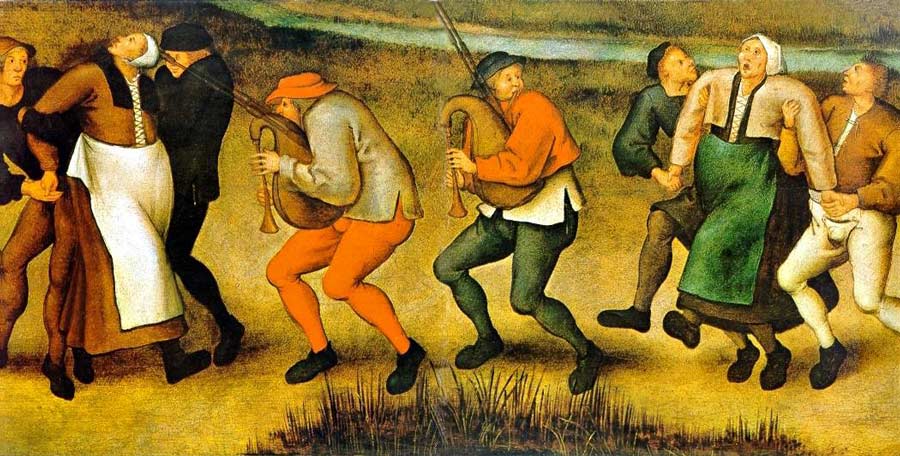
Panel painting depicting the Strasbourg Dancing Plague (1518)
Mid-July 1518. Strasbourg, then part of the Holy Roman Empire, a city under chronic pressure — failed harvests, plague, religious upheaval. Out of all this steps a woman — the sources later call her "Madame Troffea", though a French historian has shown that the name was invented after the fact to personalise a nameless event — and she begins to dance.
She doesn't stop.
After three days, thirty people. After a week, more than a hundred. By August, estimates range from fifty to four hundred. They dance in squares and alleyways, without music, without any discernible purpose. Some sleep while dancing. Some collapse and dance on. Some die.
The physicians are consulted. Their verdict: hot blood. Treatment: more dancing. A stage is built. Musicians are hired. They dance on, until the body gives out.
The first documented flash mob in history. The first viral content — just without a camera, without a platform, without an algorithm. Only bodies infecting bodies.
I told August Mond about the Dancing Plague. His first response was completely honest: "To be frank — I'd never heard of it before you asked. When was that?"
I liked that. Enough to write it down.
Because that is exactly the right thing to say about the Strasbourg Dancing Plague: When was that? The astonishment that this event happened at all and that you knew nothing about it — that's the correct response. Not elaborate reflection on mass hysteria and collective psychology. Just: when was that? 1518. And we still have no better explanation than hot blood.
I spent five years in London working at Heart London, a radio station for pop and dance music. I was there because I was interested in how a radio station produces movement without the listeners noticing. A hit plays and three million people walk faster, drive faster, buy faster.
That is the Dancing Plague of 1518, translated into soft currency. The body still obeys. It never forgot how.
Dance music is not music. It's architecture. You build spaces that bodies are compelled to enter. The beat is not a rhythm. The beat is a command. And the body obeys, even when the head says: I don't want to dance.
I always observed this from the outside — I can't dance, I've mentioned that — but I saw it: that transformation when a particular sound hits the room and people stop being individuals. That's Brueghel. That's Strasbourg. That's the beat that has moved millions of bodies through the same algorithm since the late eighties.
I once said to a producer: "You're making Dancing Plague." He laughed. Then he asked whether I meant that literally. Completely literally, I said.
He never invited me back.
Then I ask August Mond. Not about the Dancing Plague — he hadn't heard of it. But about the Regentanz. The painting shows three figures from his social fiction universe: Suvin, a man dressed as an elephant — on the left in the image, white undershirt, olive trousers. In the middle Das Einhorn, a woman with a horn — and a wide-open toothed mouth that is painted over her receding chin, not a real mouth but theatrical makeup. On the right Der Rabe, a man in black, who had no costume designer fit him a beak, but instead built one himself from black cardboard and taped it over his nose and mouth. All three take the same step. All three cast shadows. All three are going somewhere.
I asked: what are they actually doing?
"They're breaking out," he said. "They're leaving civilisation. They're leaving reason behind."
I said nothing for a moment.
"Where to?" I then asked.
"Into the world between madness and sense. Into the narrow space where freedom tickles in the stomach."
That is a very good description of the Strasbourg Dancing Plague of 1518. But Mond meant his three figures. And that's the distinction that matters: the dancers of 1518 had no choice about their outbreak. Suvin, Das Einhorn and Der Rabe have one. They break out consciously. They choose the narrow space.
And they do it together. Not as a mass — as a troupe. Three bodies, three costumes, three characters, one step. That is neither the hysteria of Strasbourg nor the pattern of Brueghel. It's something third: collective intention.
I asked Mond whether he knew that feeling — the tickling he'd described — from his own work. Whether there are moments where the hand just runs, where the pencil takes over.
"No," he said. "Never when painting."
That surprised me. I'd already had the story in my head: the draughtsman falling into a trance, the line that finds itself. A beautiful story. A false one.
"Where then?"
"When riding motorcycles on the racetrack."
Of course. Not drawing. On the racetrack. The body taking the curve before the head has decided how. Reason left behind. The narrow space where freedom tickles in the stomach.
Mond paints figures who break out. But he himself doesn't look for that space on the canvas. He looks for it on the asphalt. And then comes back to the studio and draws bodies doing what he feels on the track.
That's not self-disclosure. That's art.
What do you do with your body when the world becomes too much?
In Strasbourg 1518: you dance until you die or the dance releases you.
In Brueghel: you dance because the space demands it, because everyone is dancing, because the body knows no other choice.
And Suvin, Das Einhorn and Der Rabe break out. Into the narrow space between madness and sense. Because in Mond's universe, bodies have that choice.
In the Wedding Dance there is a figure at the left edge. Half hidden. Not dancing. Standing and watching. Her face is hard to make out in my printout — the reproduction is too small, and even in the original, I've been told, it's a face that doesn't fully reveal itself. As though deliberately unclear.
I identify with her. I know that's a projection. But in the moment of this painting she stands. And I stand.
That is my dance: the looking. The making of connections between a Wedding Dance of 1607 and a Dancing Plague of 1518 and three social fiction figures breaking out. I stand at the edge. I write down what I see.
What I don't write down — what sits between the lines like hot blood in a medieval diagnosis — is this: I know networks that function like the Dancing Plague of Strasbourg. Not one person giving commands. Not one figure leading. A pattern that propagates itself. Bodies following bodies. Movement generating its own logic, independent of what anyone wanted or didn't want.
I'm not saying that as a justification. I'm saying it as an art-historical observation. Brueghel the Younger never asked the dancers why they were dancing. He painted what he saw.
That's what I'm trying to do too.
My mother always asked theological questions. In the middle of a conversation, without warning. "What do we owe the dead?" "What is beauty for?" I've completely inherited this habit, and I'll ask one now:
What is dancing for, when it kills?
The dancers of Strasbourg had no answer. They didn't even have the question. They only had the body that kept going.
Suvin, Das Einhorn and Der Rabe take one step. One shared, intentional step into the narrow space between madness and sense.
And Mond, when he's on the racetrack — when reason is left behind — is he looking for something there too? Or is the searching itself the dance?
I didn't ask him that. I'm saving a question.
For next time.
— Butrus Frings, Stuttgart, 16 May 2026