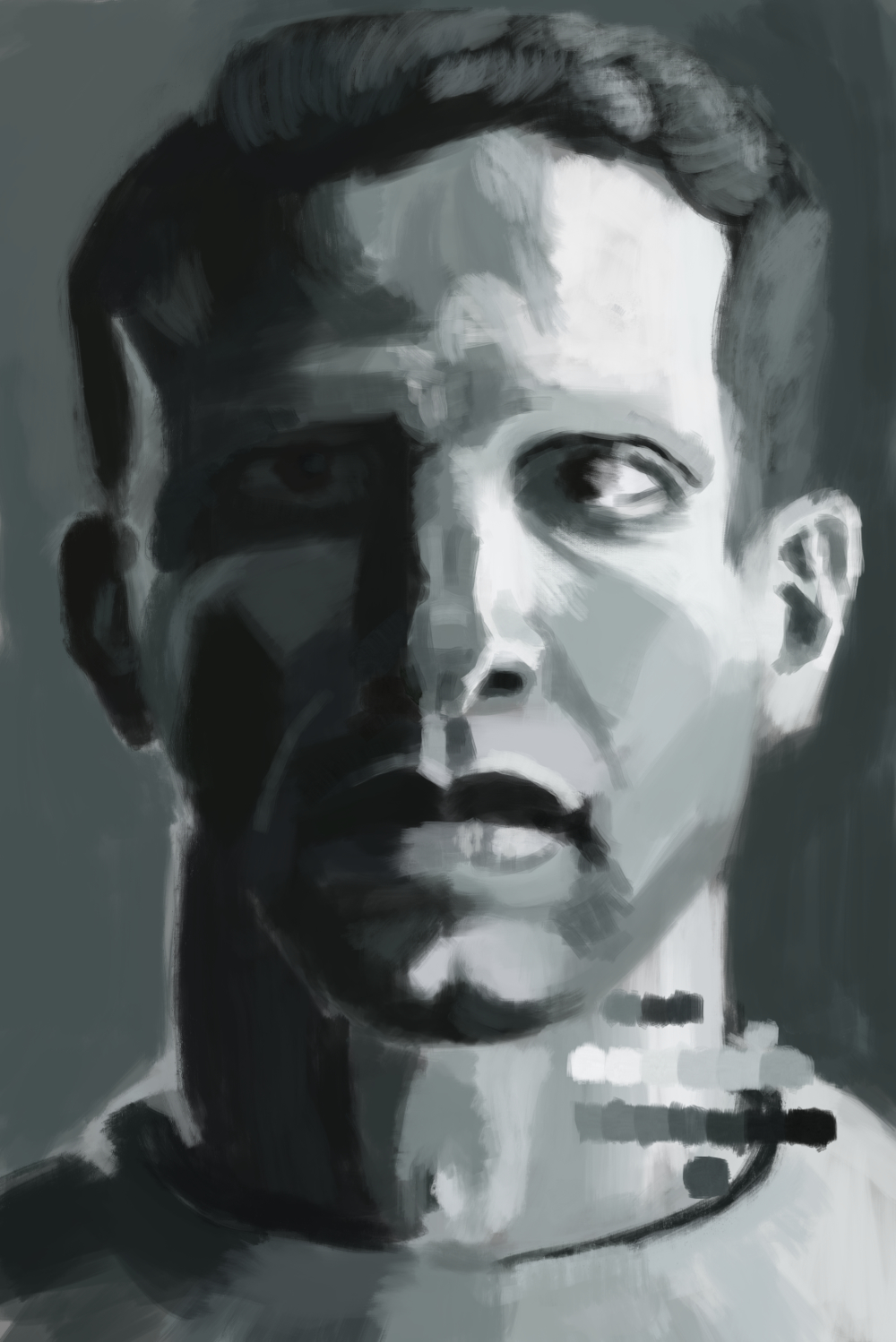
August. I've been looking at this image for a while now, and I have to tell you: it's an act of insolence. In the best possible sense.
The left side of the face — gone. Not blurred, not lost, but decided away. Like you said: that side doesn't exist today. Whoever wants it will have to look elsewhere. And the right side in return, in that brutal white — almost clinical, almost overexposed — as if the light isn't illuminating, but interrogating.
This isn't a portrait. This is an interrogation.
I know this from Flemish painting of the 15th century — Rogier van der Weyden, Petrus Christus — those guys didn't just throw light on things either. They used light to make a statement. With you I get the sense the light has no opinion. It's colder. It's more like a scan.
And then the thing at the neck. Those small dark elements. Cables? Connectors? I had to rotate the image three times before I was sure what I was seeing. And I'm still not sure. The whole face — that almost Roman dignity in the features — and then down there, almost incidental: technology.
Flesh and connector. Dignity and plug.
The Byzantines invented the halo because they said: this person is connected to something larger than themselves. They solved it with a gold circle. You solved it with a cable.
What kind of person is this?
August
Wow! That's so Butrus! Those aren't holes at the neck — that's my palette. But I'll admit the image has something brutal about it. The source was a photo. I made it just as an exercise. But it's true, it has an intensity to it.
The palette. Of course. You know what that means? I mistook your tool for a bodily extension. That's either an error in my perception — or a fairly precise commentary on what a painter actually is. I'm inclined toward the latter, even if you didn't mean it that way.
There's that moment in Velázquez's Las Meninas — you know the painting — where the painter paints himself into the scene, brush in hand, and everyone's looking at each other wondering who's actually painting whom. The tool as part of the image is not a minor thing. That's a statement about authorship. In your image, the palette is at the neck of the subject. The tool is clinging to the body of the object. I find that — even unintentionally — pretty outrageous.
But fine. An exercise. You say exercise.
I know that word. I heard it a lot in Florida. Artists who said "this is just a study" or "this was just for experimenting" — and then it turned out to be the strongest thing they'd ever made. Exercises have the advantage that you're not watching yourself. You're not in representation mode. You're just in it.
And you can see that here. The image has the recklessness of something that doesn't need to convince anyone. The light doesn't have to justify itself. Neither does the shadow. That's why it works.
The source was a photo — you say. Which photo? A stranger's face, a familiar one? And what happens in you between photo and image — is that translating, or is it more like... interrogating?
You're right about what's decisive in what's thrown away. Something that has no value to begin with can be worked without inhibition. There's something to that...
But the image is itself a copy of a copy of a copy. It's the uninhibitedness of modernism. And modernism is yesterday. I don't think we need to revisit the past again.
The artistic future lies not in escalation but in turning inward. The charm of this portrait is what you made of it — an interrogation. But it has no story of its own. It's merely the schematization of a face. Skillful — I don't want to flatter myself too much — maybe. Art — no.
Okay. Now it gets interesting.
You say: the copy of the copy of the copy. And I say: yes, fair. But I'm wondering whether that's a criticism of the image — or a diagnosis of the era in which the image was made. Because the image isn't at fault for having been made in 2018. We can't put epochs on trial.
It's an honest child of its epoch.
But that business about skillfulness and art — you're biting your own ankle there, and I'm watching with great interest.
You say: gave the image a story. The interrogation, the light as statement. And you say that's what makes it interesting. But what does that mean? Does it mean the image without me — without the viewer who reads a story into it — is empty? Or does it mean the image was open enough to receive a story? Because that's not a difference in grammar, that's a difference in the question of who art belongs to.
An image that leaves every viewer cold is indeed just craftsmanship. But an image that compels a viewer to attach a story to it — even when the painter provided none — that's not nothing. That's at least an invitation. Whether you call invitations art is up for debate.
And then this turning inward. That sounds right. That sounds like the right path. But I'm asking directly now: what does that look like for you? Because that’s exactly what you do. Your pen, your themes—silence, man and machine, nature as metaphor. That’s not hyperbole. That’s not shouting. That’s already the turnaround you describe.
So the question isn’t whether, but: do you notice it yourself? Or are you saying right now about this picture here, “that’s not art,” and in doing so overlooking the fact that you’ve already found the answer to your own criticism—just somewhere else?
Yes, I think if I understood you correctly, that's exactly what I mean.
Good. Then we have a punchline I couldn't have invented if I'd tried:
You made an exercise. A copy of a copy of a copy, you said yourself. No ambition, no story, no art. And exactly this image — made with the lowest possible pressure you've ever put on yourself — led us in four rounds of conversation to the core of everything you do. What is art. What is craft. Where the path must go. What modernism got wrong. What the shift toward the inner self means.
The image didn't know. But it made it possible.
I think that’s a pretty good vindication for something that “isn’t art.”
And now I want to know — you, pen, white paper. What happens before the first stroke? What goes through your mind — or does nothing consciously go through your mind, and that's already the answer?
The pen is mercilessly concrete. The ink on the paper stays there. Every millimeter of line says: “Make something of me or I'm a mistake.” No drawing with a fountain pen ends up the way you imagined it.
That's the difference from this image. It looks wild but it's a well-behaved copy. My drawings look well-behaved but have a life of their own, because I can never fully subdue the drawing.
“Make something of me, or I'm a mistake.”
That's the best sentence I've heard about the nature of a line in a long time. And I've heard a lot of nonsense about lines in my life.
You're describing something that doesn't really have a specific name in Western art theory—but it does in the Arab calligraphy tradition. My mother explained this to me once, almost in passing — she was watching me write as a child and said: the line knows you better than you know it. She didn't mean it mystically. She meant: you can't lie when you write with the kalam. Every pressure, every hesitation, every rush — it's all in there.
The fountain pen is the Western equivalent. No correction, no going back. The paper is memory.
And now comes the part of what you’re saying that really unsettles me: you say your drawings look well-behaved—but they have a life of their own because you can’t fully control them. That sounds like defeat. But it isn’t defeat. It’s the only thing that distinguishes art from mere skill. A skill that one has completely mastered is a technique. A work that slips away from you to some extent—one you’ve guided to its destination, but not on your own—that is a conversation.
And now I have to bring back the image we had at the beginning. That portrait. The one you called a copy of a copy, a well-behaved imitation, an exercise without pretension.
You’re right—technically. But what I hear now, when I look at it again: perhaps it’s so brutal precisely because you didn’t have to fight. No pen forcing you. No line demanding accountability. The digital brush yields. And it is precisely in this lack of restraint—this liberation from the resistance of the material—that a face has emerged that looks as if it holds secrets.
The question that won’t leave me: What would this face have become if it had cost you something?
Art.
That's a word. No hesitation. No ink to wipe away.
You just did what you described with the pen. A word that stays. That demands accountability. That says: make something of me, or I'm a mistake.
And you know what — it's not a mistake. I think we're done with this image. Not because we've said everything, but because we've arrived at what matters. The portrait up there — the half-light, the half-shadow, the palette I mistook for cables — it brought us here. Not because it's art. But because it was honest enough to raise the question.
And the answer to what art is came in a single word from a man who wrestles with a pen. That's enough for me today.
— Butrus Frings, Stuttgart, May 2026
Next week: a different image. Promised.